



Biomedical Engineering
Bridging engineering innovation with healthcare solutions for better human life and medical care
About the Department
The Department of Biomedical Engineering was established in 2015 with the vision of creating professionals who can bridge the gap between engineering and healthcare. Our program integrates engineering principles with biological and medical sciences to develop solutions for healthcare challenges through innovative medical devices, diagnostic systems, and therapeutic technologies.
Vision
Produce competent Biomedical Engineering professionals with scientific temper, values, ethics, team spirit and capabilities to face new challenges.
Mission
- Provide conducing learning environment with state-of-the-art infrastructure facilities, laboratories and teaching learning systems.
- Produce skilled Biomedical Engineers with skills towards employability, leadership, communication skills with social responsibilities and ethical values.
- Inculcate Professional skills to function as proficient engineers and designers capable of building sustainable equipment/systems and infrastructure for the society.
- Promote research and development activities in the rapidly changing technologies related to Biomedical Engineering and allied domains.
PEO1: Foundational Concepts
To enable the graduates to demonstrate their skills in design and develop medical devices for health care system through the core foundation and knowledge acquired in engineering and biology.
PEO2: Professionalism
To enable the graduates to exhibit leadership in health care team to solve health care problems and make decisions with societal and ethical responsibilities.
PEO3: Innovation
To Carryout multidisciplinary research, addressing human healthcare problems and sustain technical competence with ethics, safety and standards.
- PO-1: Engineering knowledge: Apply the knowledge of mathematics, science, engineering fundamentals, and an engineering specialization to the solution of complex engineering problems.
- PO-2: Problem analysis: Identify, formulate, review research literature, and analyze complex engineering problems reaching substantiated conclusions using first principles of mathematics, natural sciences, and engineering sciences.
- PO-3: Design/development of solutions: Design solutions for complex engineering problems and design system components or processes that meet specified needs with consideration for public health safety, and cultural, societal, and environmental factors.
- PO-4: Conduct investigations of complex problems: Use research-based knowledge and research methods including design of experiments, analysis and interpretation of data, and synthesis of the information to provide valid conclusions.
- PO-5: Modern tool usage: Create, select, and apply appropriate techniques, resources, and modern engineering and IT tools including prediction and modeling to complex engineering activities with an understanding of the limitations.
- PO-6: The engineer and society: Apply reasoning informed by the contextual knowledge to assess societal, health, safety, legal and cultural issues and the consequent responsibilities relevant to the professional engineering practice.
- PO-7: Environment and sustainability: Understand the impact of the professional engineering solutions in societal and environmental contexts, and demonstrate the knowledge of, and need for sustainable development.
- PO-8: Ethics: Apply ethical principles and commit to professional ethics and responsibilities and norms of the engineering practice.
- PO-9: Individual and team work: Function effectively as an individual, and as a member or leader in diverse teams, and in multidisciplinary settings.
- PO-10: Communication: Communicate effectively on complex engineering activities with the engineering community and with society at large, such as, being able to comprehend and write effective reports and design documentation, make effective presentations, and give and receive clear instructions.
- PO-11: Project management and finance: Demonstrate knowledge and understanding of engineering and management principles and apply these to one's own work, as a member and leader in a team, to manage projects in multidisciplinary environments.
- PO-12: Life-long learning: Recognize the need for, and have the preparation and ability to engage in independent and life-long learning in the broadest context of technological change.
PSO1: Core Skills
To design and develop diagnostic and therapeutic devices that reduces physician burnout and enhance the quality of life for the end user by applying fundamentals of Biomedical Engineering.
PSO2: Problem Solving Skills
To apply software skills in developing algorithms for solving healthcare related problems in various fields of Medical sector.
PSO3: Social Consciousness
To adapt to emerging information and communication technologies (ICT) to innovate ideas and solutions for current societal and scientific issues thereby developing indigenous medical instruments that are on par with the existing technology.
4 Years
Program Duration
60
Annual Intake
88%+
Placement Rate
AICTE
Approved
Our curriculum is designed to provide comprehensive knowledge in biomedical engineering fundamentals while emphasizing practical applications in medical device design, biotechnology, and healthcare systems.
Curriculum and Syllabus 2023
Our department features a distinguished team of faculty members with expertise spanning biomedical engineering, medical device design, and healthcare technology.
Dr.S.P.SELVARAJ
Professor
ME PhD
Dr.B.VASUMATHI
Associate Professor
ME PhD
Dr.K.TAMILSELVAN
Associate Professor
BE ME
T.K.RAGAVI
Assistant Professor
BE ME
D.KAVITHA
Assistant Professor
BE ME
S.KARTHIK
Assistant Professor
BE ME
R.PADMANABHAN
Assistant Professor
BE ME
C.DEEPA
Assistant Professor
BE ME
K.BOOPATHI
Assistant Professor
BE ME
P.GOPALAKRISHNAN
Assistant Professor
BE ME
- Best Teacher Awards from BMESI and other professional bodies
- Research grants from DBT, ICMR, and medical device companies
- Collaborations with leading hospitals and healthcare institutions
- Patents in medical device design and biomedical instrumentation
Department Facilities
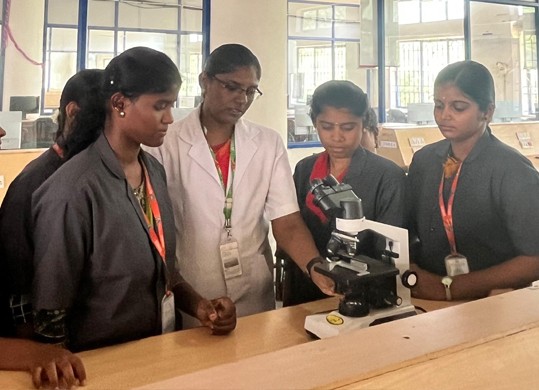
Advanced lab with ECG, EEG, EMG machines, patient monitors, and biomedical signal acquisition systems for medical instrumentation studies.
Equipped with ultrasound systems, X-ray imaging setups, and image processing software for medical imaging applications.
Specialized lab for biomaterial testing, characterization, and development of biocompatible materials for medical applications.
Clean room facility with cell culture equipment, incubators, and tissue engineering platforms for regenerative medicine research.
Lab with prosthetic and orthotic devices, mobility aids, and assistive technology for rehabilitation engineering studies.
Hospital simulation environment with medical equipment maintenance tools and healthcare technology management systems.
- MATLAB/Simulink
- LabVIEW
- ImageJ
- SolidWorks
- ANSYS Fluent
- COMSOL Multiphysics
- 3D Slicer
- OsiriX
- BioPac Systems
- Artec Studio 3D
Our department is committed to cutting-edge research in diverse areas of biomedical engineering, fostering innovation, and collaborating with industry and academic partners to solve real-world healthcare challenges.
- Medical Device Design
- Medical Imaging & Signal Processing
- Biomaterials & Tissue Engineering
- Rehabilitation & Assistive Technology
- Nanotechnology in Medicine
- AI-powered Medical Diagnostic System
- Smart Prosthetic Limb with Neural Control
- Portable ECG Device for Rural Healthcare
- Biocompatible Materials for Implants
- 100+ research papers published in reputed journals
- Funded projects from DBT, ICMR, and industry partners
- Multiple patents filed in medical device and biomedical instrumentation domains
- Faculty serving as reviewers and editorial members of leading biomedical journals
Department Activities
- Biomedical Engineering Society – Student society focusing on biomedical innovation, medical device development, and healthcare technology projects.
- Medical Innovation Club – Club dedicated to developing innovative solutions for healthcare challenges and medical device prototyping.
- Biomaterials Research Group – Research-oriented group working on biomaterials development and tissue engineering projects.
- Healthcare Technology Forum – Platform for discussing latest healthcare technologies, medical trends, and industry developments.
- MEDTECH – Annual biomedical engineering symposium and exhibition
- DeviceDesign – Medical device design competition
- BioInnovate – Innovation competition for healthcare solutions
- HealthHack – Hackathon for digital health applications
- ClinicalConnect – Medical professional networking event
- Hospital visits to major healthcare institutions
- Medical device company industrial visits
- Guest lectures by healthcare industry professionals
- Internship programs with medical device manufacturers
- Clinical attachments with practicing physicians
- Medical device design and development workshops
- Clinical engineering training programs
- Biomedical instrumentation hands-on training
- Healthcare regulations and FDA approval processes
- 3D printing in medical applications workshops
- Healthcare communication and patient interaction skills
Department Gallery
AHP Lab


ASSOCIATION SEMINAR- SVHEC SEMINAR HALL – 08.09.2025


INDUSTRIAL VISIT – GH-PERUNDURAI – 25.9.2025


INDUSTRIAL VISIT – TIRUVANANTHAPURAM – 12.09.2025


INSUSTRIAL VISIT – TAMILNADU VOLUNTARY BLOOD BANK, ERODE – 25.09.2025


PLACEMENT TRAINING - SVHEC - 03.12.2025 TO 16.12.2025


Ready to Join Biomedical Engineering?
Bridge engineering innovation with healthcare solutions. Contact our department for more information about the program and admission process.